
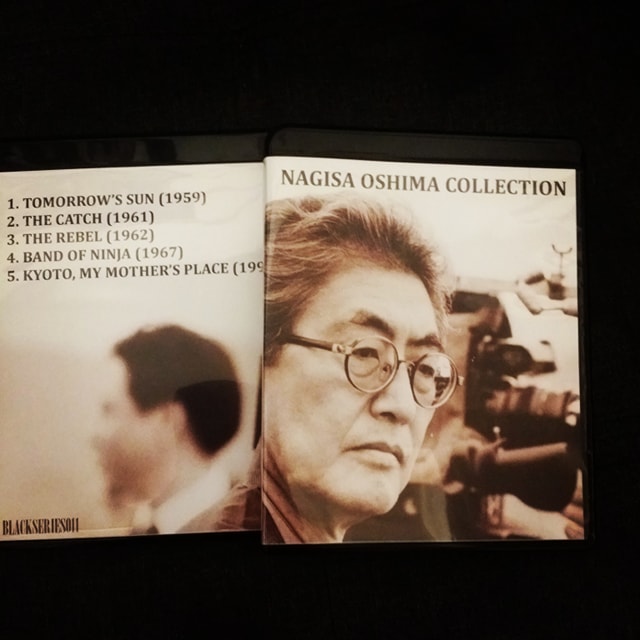
Nagisa Oshima: 5 Film Collection | Region-Free (Blu-Ray) | English Subs
| Edition | Format | Price | Stock |
|---|---|---|---|
| Standard | Blu-ray | $11.99 | In stock |

Information about this release from the publisher
Title: Tomorrow’s Sun (1959)
Genre: Comedy, Romance, Action
Plot Synopsis:
A playful short film presented as a trailer for a fictional feature, Tomorrow’s Sun spoofs popular Japanese film genres of the late 1950s. This satirical piece showcases various cinematic styles, from melodramatic beach romances and vibrant musical numbers to comical gangster scenarios and historical samurai battles, highlighting the versatility and emerging talents of Shochiku’s young actors.
Cast and Crew:
- Director: Nagisa Ōshima
- Writer: Nagisa Ōshima
- Cast:
- Yukiyo Toake
- Toyozō Yamamoto
- Miyuki Kuwano
- Naoki Sugiura
- Eiko Kujo
YouTube Trailer:
Tomorrow’s Sun (1959) | Trailer
IMDb Link:
Tomorrow’s Sun (1959)
Reviews from Letterboxd:
-
Dr. Ethan Lyon – ★★★
“Light and breezy piece of comedy by Oshima at the start of his career while at Shochiku. Ostensibly a promotion for a number of young stars at the time (none of whom would become recognizable names), it’s an opportunity for him to poke fun at the seriousness of the starmaking system with some witty breaking of the fourth wall and some deliberately hokey effects for the Chambara sequence.” -
col_plimp – ★★★½
“In diesem ersten kurzen Trailer ist zwar noch nichts politisch oder provozierend, aber auch schon meta-parodierend und modern stellt er in Tomorrow’s Sun einige aufstrebende Jungschauspieler seines neuen Studios in ganz kurzen unterschiedlichsten Filmszenarien vor; von Melo-Strandromantik, bunten Musicalnummern, albernen Gangstern bis zu historischen Samurai-Kämpfen.” (In this first short trailer, there is nothing political or provocative yet, but it is already meta-parodic and modern, presenting some up-and-coming young actors from his new studio in a variety of brief cinematic scenarios—from melodramatic beach romances and colorful musical numbers to silly gangsters and historical samurai battles.) -
BazingaMoops – ★★★★
“A goofy, lighthearted mock trailer showcasing Shochiku’s roster of upcoming actors. In retrospect, some would go on to much more successful careers than others, but I feel they all showed promise. A reason most will check out this short is because it is Nagisa Oshima’s first film as a director, following it up with a debut feature. He, too, shows promise behind the camera.”
Meta Description:
A satirical short film by Nagisa Ōshima, Tomorrow’s Sun (1959) parodies various Japanese film genres of the era. Presented as a mock trailer, this early work showcases Shochiku’s emerging talents while reflecting Ōshima’s playful and experimental approach to filmmaking.
Title: The Catch (1961)
Genre: Drama, War
Plot Synopsis:
During the final days of World War II, a black American pilot is captured and held prisoner by a rural Japanese village. As the villagers struggle with what to do with their “catch,” deep-seated prejudices and moral dilemmas come to the surface, exposing the dark realities of war and human nature. The film explores themes of power, fear, and the consequences of wartime ideology.
Cast and Crew:
- Director: Nagisa Ōshima
- Writers: Tsutomu Tamura (screenplay), Kenzaburō Ōe (novella)
- Cast:
- Rentarō Mikuni as Kazumasa Takano
- Hugh Hurd as the American soldier
- Akiko Koyama as Hiroko Ishii
- Yōko Mihara as Sachiko Tsukada
- Masako Nakamura as Kazumasa’s daughter-in-law
YouTube Trailer:
The Catch (1961) | Trailer
IMDb Link:
The Catch (1961)
Reviews from Letterboxd:
-
Filipe Furtado – ★★★½
“Nagisa Oshima’s first independent feature about what a WWII-era Japanese village does when it has to take care of the titular catch (an American pilot played by Shadows’ Hugh Hurd). It plays all the allegorical notes expected from an Oshima film about Japan’s continuous flirtation with fascism, but even if it lacks surprises, his scope framing is as sharp as ever; the image here truly is a weapon.” -
Corwyn – ★★★
“We just discussed it and decided that everything that happened during the war never happened.” -
Luka – ★★★★
“Nagisa Ōshima’s fifth film, his first independent work, and generally one of the hardest of his restored films to track down. A relentlessly bleak wartime portrait of democratic infighting among the proletariat class.”
Meta Description:
A haunting war drama, The Catch (1961) explores the moral dilemmas of a rural Japanese village that captures a black American pilot during World War II. Directed by Nagisa Ōshima and based on Kenzaburō Ōe’s novella, the film examines the themes of racism, fear, and the dark side of human nature in wartime.
Title: The Christian Revolt (1962)
Genre: Drama, History, War
Plot Synopsis:
In 1637, during the Tokugawa era in Japan, a group of oppressed Christian peasants in the Shimabara region rises against the shogunate’s tyranny. Led by the charismatic rebel leader Shiro Amakusa, they challenge the oppressive regime in a desperate bid for freedom and religious tolerance. Facing overwhelming odds, the rebels must rely on their faith and courage to stand against the might of the shogunate’s forces.
Cast and Crew:
- Director: Nagisa Ōshima
- Writers: Nagisa Ōshima, Toshirō Ishidō
- Cast:
- Hashizō Ōkawa as Shiro Amakusa
- Ryūtarō Ōtomo as Shinbei Oka
- Rentarō Mikuni as Uemonsaku
- Satomi Oka as Sakura
- Sayuri Tachikawa as Okiku
IMDb Link:
The Christian Revolt (1962)
Reviews from Letterboxd:
-
plaidflannel – ★★★★★
“THIS IS OUR STAND! Brutal. Philosophical. Rhetorical. This was so much better than I’d expected it to be. Tension all the way through. Outstanding camerawork of exquisite long takes that convey a gut-wrenchingly engaging story that asks real questions. Beautiful film and a new favorite for sure.” -
Daniel – ★★
“Oshima’s brutal look at the persecution of Christians in 17th century Japan is incredibly interesting on paper. However, it doesn’t really work for me in its execution. The film is slow and theatrical to a fault, with dull and dialogue-heavy storytelling.” -
dirtylaundri – ★★★★½
“How to fight a losing battle. Really surprising that this isn’t better known. To me, it’s much more engaging than The Catch, and I guess most early Oshima.” -
PsychoLad – ★★★½
“Fighting a losing battle because in the end, winning it for the martyrdom in heaven. Badassery maxxing right here.” -
Craig J. Clark – ★★★
“Further evidence—alongside both versions of Silence—that when it came to Christianity, feudal Japan wasn’t having it. I’ve seen persecuted Christians get crucified before (that’s kind of a gimme), but this is the first time I’ve seen ‘straw dancing.’”
Meta Description:
A historical drama, The Christian Revolt (1962) follows the 1637 Shimabara Rebellion, where Christian peasants, led by Shiro Amakusa, rise against the Tokugawa shogunate’s oppressive rule. Directed by Nagisa Ōshima, the film portrays a powerful struggle for faith and freedom in feudal Japan.
Title: Band of Ninja (1967)
Genre: Animation, Action, Drama, War
Plot Synopsis:
Set during Japan’s Sengoku period, Band of Ninja follows Kagemaru, a skilled ninja who becomes involved in a peasant uprising against oppressive feudal lords. The film uniquely presents its narrative by filming still images from Sanpei Shirato’s manga, accompanied by voiceovers and sound effects, creating a “motion comic” experience.
Cast and Crew:
- Director: Nagisa Ōshima
- Writers: Nagisa Ōshima, Mamoru Sasaki
- Based on the Manga by: Sanpei Shirato
- Cast:
- Rokkō Toura as Kagemaru
- Kei Yamamoto as Jūtaro Yūki
- Akiko Koyama as Akemi
- Fumio Watanabe as Oda Nobunaga
- Hikaru Hayashi as Toyotomi Hideyoshi
IMDb Link:
Band of Ninja (1967)
Reviews from Letterboxd:
-
Lencho of the Apes – ★★★
“How interesting, an anime made up entirely of still pictures—it’s like Oshima’s La Jetée or something, only ninjas. And these ninjas have such offbeat fighting styles-n-specialties that they’re like feudal-J X-Men. It didn’t really hold my attention very tightly, but bonus points for that bit toward the beginning where they reference Diego Rivera’s paintings.” -
Lydia Roberts – ★★½
“Oshima’s inherently interesting and this makes for an experiment of note in theory but a lot less so in practice—I’m not sure if the idea can be necessarily improved upon with better sound design, but for now his experiment in literally adapting manga panels is one I’m fine with considering his worst film.” -
Alexander Wood – ★★½
“Wildly creative, but also wildly not my thing at all. There’s about 5000 different characters in this two-hour picture-reel quasi-anime, and they all are about as distinct as this brief jaunt through the material allows them to be. I understand why Oshima picked the manga he did. It sort of feels like an attempt to go bigger and more epic than The Christian Revolt but done so without the budget needed for such an excursion. In any case, one of the more curious outliers in Oshima’s increasingly eclectic filmography. If I told you the same guy who did In the Realm of the Senses made an ‘animated’ chanbara epic in the 1960s you’d scarcely believe me. Not very good (the exposition and narrator also greatly detract), but fascinating as a curiosity.”
Meta Description:
Band of Ninja (1967) is an experimental Japanese film directed by Nagisa Ōshima. It adapts Sanpei Shirato’s manga by filming still images accompanied by narration and sound effects, creating a unique “motion comic” experience. The story follows Kagemaru, a ninja involved in a peasant uprising during the Sengoku period.
Title: Kyoto, My Mother’s Place (1991)
Genre: Documentary
Plot Synopsis:
Nagisa Ōshima reflects on the history and culture of Kyoto, intertwining the city’s past with his own personal narrative and relationship with his mother. Through intimate interviews, traditional performances, and personal memories, Ōshima explores the complex emotions he holds toward his hometown, the traditions that shaped his family, and the lingering presence of imperial Japan in Kyoto’s identity.
Cast and Crew:
- Director: Nagisa Ōshima
- Writer: Nagisa Ōshima
- Cast:
- Nagisa Ōshima as Himself
- Ina Funatsuki as Herself
- Tomi Shimada as Herself
- Hikohachi Yamamoto as Himself
IMDb Link:
Kyoto, My Mother’s Place (1991)
Reviews from Letterboxd:
-
Rit – ★★★★½
“The most moving documentary one could make about a place they grew up in and vehemently hated. Ōshima, through documenting his mother’s life against the backdrop of Kyoto’s history, ties imperial Japan, whose legacy never quite faded, to his mother’s doomed fate of being a lifelong Kyoto-woman.” -
SimBelm – ★★★★
“Once declared the ‘buried treasure’ of Nagisa Ōshima’s career by Martin Scorsese, Kyoto, My Mother’s Place is certainly one of the brightest gems hidden among Ōshima’s great filmography. Commissioned by BBC Scotland, this documentary is Ōshima’s ode to his mother, merging explorations of her life, his home city Kyoto, and his own identity.” -
Sharjel – ★★★★★
“Wanting to burn down your hometown is something I can relate to.” -
Chantal – (No rating)
“Came to this blindly, I just saw it on Martin Scorsese’s Letterboxd likes lol. I’m a huge fan of mid-century, women-centered Japanese domestic dramas, particularly those of Naruse, so I thought a lot about them while watching this. Women caught between modernity and tradition, women who live and suffer in the quiet dignity they’ve learned (for better or worse).” -
Squalitooooooo – ★★★★★
“Extremely touching to listen to Nagisa Ōshima speak with modesty but a lot of tenderness about his mother, his family, their customs, and traditions. He presents us with his city of Kyoto, with which he has a love/hate relationship. We learn a lot about the city and its history as well as the personal history of the Ōshima family.”
Meta Description:
A deeply personal documentary, Kyoto, My Mother’s Place (1991) follows acclaimed director Nagisa Ōshima as he explores the history of Kyoto through the lens of his own life and relationship with his mother. Blending historical insight with intimate storytelling, this reflective documentary offers a rare glimpse into Japan’s cultural past and one filmmaker’s deeply emotional connection to his roots.
History
- Tracking started